
HUMAN READINESS GAP
THE
SAME PERSON.
TWO DIFFERENT OPERATING CONDITIONS.
WHAT WE SEE
Outward Behavior
DRIVEN
PREPARED
RESPONSIBLE
COMPOSED
HIGHLY CAPABLE
WHAT WE DON'T SEE
Internal Operating State
FEAR OF FAILURE
SELF-DOUBT
PROVING
SUPPRESSION
EXTERNAL WORTH
THESE ARE NOT EQUIVALENT OPERATING CONDITIONS
If we only evaluate the behavior we can see, we can reward the very patterns that are quietly consuming the person's capacity.

GRAY MATTER
THAT IS THE GAP
IS DESIGNED TO ADDRESS
Performance is not the problem.
The question is what is driving the struggle behind it.
Capability can hide the cost.
THE QUESTION BECOMES
What is helping this person perform, and what is that same internal pattern costing them over time?
THE HUMAN READINESS GAP
RESILIENCY IS NECESSARY.
BUT IT IS NOT THE ONLY PIECE
Resilience training strengthens coping, stress management, and adaptation.
But human readiness under sustained pressure involves more than the ability to endure, recover, or continue performing.
THE QUESTION IN NOT WHETHER RESILIENCE MATTERS.
IT IS WHETHER IT IS ENOUGH.

THE GAP IS NOT RESILIENCE.
THE GAP IS SCOPE.
Research increasingly points toward a broader picture shaped by stressor exposure, individual patterns, leadership, organizational culture, recovery, social connection, and access to support.
WHAT RESILIENCY TRAINING DOES WELL
Resilience programs can help people develop adaptive coping strategies, cognitive skills, stress-management techniques, mindfulness, and greater confidence responding to adversity.
COPING SKILLS
Tools to manage stress and regulate emotions.
SELF-EFFICACY
Belief in one's ability to face challenges.
ADAPTATION
Flexibility to adjust and move forward.
CONNECTION
Building support and belonging.
Those skills belong in the readiness equation. The problem is assuming they are the entire equation.
DESERVE MORE ATTENTION
FOUR AREAS THE RESEARCH SAYS


THIS EXPANDS READINESS BEYOND:
CAN THEY HANDLE STRESS? TO:
What is this environment asking the person to adapt to, and have we prepared them to understand that adaptation?
Do they understand what the stress is doing while they are inside it, and can they recover when it is no longer required?

01 | EXPOSURE
THE PERSON DOES NOT OPERATE SEPARATELY FROM THE ENVIRONMENT
The human stress response does not operate independently of the environment.
DoD guidance recognizes that combat and operational stress reactions can vary according to factors including intensity, duration and frequency of exposure, leadership, unit morale, workload, sleep disruption, interpersonal stress, danger, trauma, and loss. These reactions can affect sleep, attention, emotion, cognition, behavior, and connection without automatically constituting a mental-health disorder.
That distinction matters.
A person may be functioning exactly as the environment requires while their brain and body become increasingly practiced at vigilance, rapid response, suppression, threat detection, or operating without adequate recovery.
The adaptation is useful. The question is whether the system can recalibrate when the demand changes, when they return home, when they change jobs.
Learn how the exposure profile is changing with modern warfare.
02 | INTERNAL DRIVERS
PEOPLE DO NOT ENTER PRESSURE AS BLANK SLATES
People enter high-pressure environments with existing beliefs about competence, responsibility, failure, control, worth, belonging, vulnerability, and what they believe they must do to succeed.
That can create patterns such as:
Performance-based identity
Imposter feelings
Perfectionism concerns
Emotional suppression
Over-responsibility
Self-sabotage behaviors
Control patterns
Isolation + delayed help-seeking
These patterns are not evidence that someone lacks resilience.
In fact, some can hide behind behaviors high-pressure cultures value: high standards, preparation, responsibility, composure, independence, sacrifice, and the ability to keep going.
CAPABILITY DOES NOT TELL YOU WHAT IS DRIVING IT. The same outward behavior can come from very different internal places.
EXAMPLES: PERFECTIONISTIC STRIVING VERSUS PERFECTIONISTIC CONCERNS & IMPOSTER PHENOMENON
High standards may reflect healthy ambition, or they may be driven by fear of failure, self-criticism, and the belief that mistakes threaten competence or worth. That distinction matters because research consistently separates perfectionistic striving from perfectionistic concerns. In a meta-analysis of 43 studies involving 9,838 participants, perfectionistic concerns were positively associated with burnout, while perfectionistic striving showed small negative or nonsignificant relationships with burnout.¹
More recent workplace research sharpens that point. A 2025 meta-analysis found that both perfectionistic striving and perfectionistic concerns were associated with working more hours, but only striving was associated with better job performance. Perfectionistic concerns increased effort without producing a corresponding performance benefit.²
Impostor phenomenon creates a similar disconnect between external competence and internal experience. A systematic review of 62 studies found impostor phenomenon associated with anxiety, depression, burnout, and lower job satisfaction across professional and academic populations.³

03 | CONNECTION + COMMUNITY
RESILIENCY IS NOT ONLY AN INDIVIDUAL RESPONSIBILITY
Connection, cohesion, leadership, and culture matter.
CDC identifies feeling connected to others, supportive relationships, cultural identity, coping skills, and access to quality care among protective factors associated with lower suicide risk.
Military-specific research points in the same direction.
Army research has associated greater social closeness and support with lower suicide risk. Other studies using Army STARRS data have examined unit cohesion as a potentially important protective factor, and research has associated stronger post-deployment social support with fewer suicidal thoughts.
A 2026 systematic review of military resilience makes the larger point especially clear: research has historically concentrated heavily on individual-level resilience factors, while leadership behavior, organizational practices, structural conditions, access to resources, belonging, and cultural barriers remain comparatively under-examined. The authors explicitly argue for a more systemic, multilevel approach to military resilience.
YOU CANNOT PLACE THE ENTIRE BURDEN OF RESILENCE ON THE PERSON EXPERIENCING THE PRESSURE.
HUMAN READINESS OPERATES AT MANY LEVELS
This does not remove individual responsibility.
It puts individual responsibility inside the system where people actually operate.
INDIVIDUAL
Awareness • coping • regulation • identity • help-seeking
TEAM
Trust • belonging • cohesion • peer support • shared language
LEADERSHIP
Modeling • recognition • psychological safety • response to strain
ORGANIZATION
Culture • workload • resources • recovery • stigma • structural conditions
Are we only strengthening the individual, or are we also strengthening the conditions around them?
04 | DELIVERY + ACCESS
TRAINING & SUPPORT HAS TO REACH THE PERSON, NOT JUST MEET THE REQUIREMENT.
Good content is not enough if people do not absorb it, trust it, recognize themselves in it, or use it when something starts to change.
In May 2026, the Government Accountability Office reported that the military services had not fully evaluated the effectiveness of their annual suicide-prevention training. GAO specifically noted the need to determine whether training is actually producing intended outcomes rather than relying primarily on completion, surveys, or knowledge checks.
The DoD’s Suicide Prevention and Response Independent Review Committee recommended moving away from one-size-fits-all training toward smaller groups, audience-specific content, better-prepared facilitators, varied frequency and duration, and more choice in relevant topics.
That principle reaches beyond suicide prevention: training has to reach the person, not just meet the requirement.

EDUCATION SHOULD HELP PEOPLE RECOGNIZE WHAT IS HAPPENING EARLIER
BUT RECOGNITION ONLY WORKS IF PEOPLE ARE WILLING & ABLE TO SEEK SUPPORT
ACCESS IS PART OF THE READINESS GAP.
The Military Health System is operating with documented behavioral-health capacity constraints. A 2024 GAO review found civil-service behavioral-health vacancies above 40% at military treatment facilities. When military facilities could not meet demand, service members were referred to civilian care, where average waits were about one month for routine care and 2–3 weeks even for urgent behavioral-health referrals.
AVAILABILITY DOES NOT GUARANTEE USE.
Even when care exists, service members do not always access it. A systematic review of 111 military studies found that only 29.3% of service members experiencing mental-health problems had used mental-health services in the previous year. Stigma and perceived career consequences were common barriers; supportive leaders, family, and peers helped facilitate care.
COMMON BARRIERS TO CARE
STIGMA
Being perceived as weak, crazy, fragile, or unable to do duties.
CAREER IMPACT
Losing clearances, being removed from roles, or no longer trusted to do their job.
TREATED DIFFERENTLY
Treated as fragile, a problem, weak, or untrustworthy.
DISCLOSURE
Worried about others finding out what they are carrying on the inside.
That creates an important space in the readiness continuum:
A person may know something is changing and still not seek formal mental-health care.
THE GOAL IS NOT ONLY SUICIDE PREVENTION
IT IS EARLIER AWARENESS OF HUMAN STRAIN DRIVERS
People can remain highly capable while internal strain is building. Earlier awareness means understanding what the person may already be carrying internally and what the operational environment may be adding to it BEFORE it becomes a crisis.

THE SPACE BETWEEN "I'M FINE" AND CRISIS MATTERS
High professionals will continue:
-
Leading
-
Deploying
-
Taking care of others
-
Responding to emergencies
-
Meet deadlines
-
Make decisions
-
Complete the mission
All while carrying harsh internal drivers and operational stress. Until the cost is too much.
INTERNAL DRIVERS
What the person may already be carrying
Performance-based identity
Self-doubt + Imposter thoughts
Perfectionism + constant proving
Over-responsiblity
Control + hyper-independence
Emotional suppression
Isolation + delayed help seeking
These patterns create pressure even when someone is capable.
OPERATIONAL STRESS
What the environment adds
Sleep disruption
Hypervigilence + constant scanning
Irritability + shortened fuse
Difficulty shutting the brain off
Emotional disconnection
Chronic activiation
Feeling different + isolated
The environment reinforces survival responses long after the threat is gone.

When internal drivers and operational stress compound, strain builds long before performance fails.
Earlier awareness gives people language for what is happening, reduces isolation, and creates more opportunities to respond before the cost becomes crisis.
WHY THE BASELINE MATTERS
WHAT ARE THEY BOUNCING BACK TO?
Military resilience programs have evolved across the services, including Army Comprehensive Soldier and Family Fitness, Air Force resilience efforts, Navy Operational Stress Control, and Marine Corps OSCAR. They provide valuable skills around coping, adaptation, stress management, relationships, and psychological fitness.
But resilience assumes there is a healthy place to recover to.
What if the person's existing baseline is already:
-
Chronically activated.
-
Driven by perfectionism or proving.
-
Over-responsible.
-
Emotionally suppressed.
-
Disconnected from others.
-
Reluctant to ask for help.
Teaching someone to recover from the next stressor may help them function again. It does not automatically change the internal patterns they are returning to.
That distinction is supported by a review of U.S. military resilience programs that identified gaps between resilience theory and applied practice, particularly the need to account more fully for operational stress, operational tempo, unit functioning, and the individual and environmental factors influencing psychological readiness.
THE RAISING THE BASELINE GRAPH: Both lines experience ongoing operational stress. The difference is where they return between stressors.
The lower line starts from a depleted baseline. Each new demand produces a larger swing, recovery becomes less complete, and the person has less internal capacity available before the next stressor arrives.
The raised baseline does not eliminate pressure or prevent difficult periods. It creates a higher, more stable point of return, so fluctuations are less extreme and recovery requires less effort.
The graphic illustrates the core idea: the same stress load can have a very different long-term cost depending on the condition of the baseline underneath it.
Conceptual illustration only; not a longitudinal empirical dataset.

THE QUESTION IS NOT
"How quickly can they bounce back?"
IT IS:
"What are they bouncing back to?"
If the baseline itself is creating additional strain, the goal cannot only be recovery to baseline. The baseline has to change.
MODEL OF HUMAN READINESS
A MORE COMPLETE
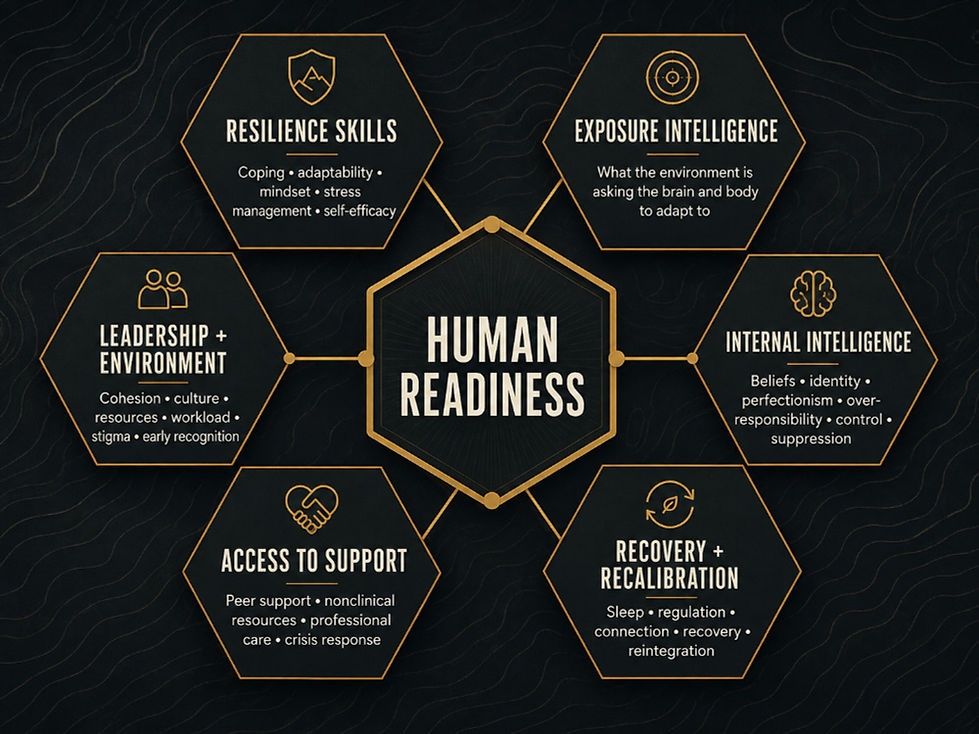
PREPARE THE PERSON. SUPPORT THE ENVIRONMENT. SUSTAIN THE CAPABILITY

WHERE GRAY MATTER FITS
Designed to strengthen the space between resilience training and mental-health care by addressing the space between them.
Gray Matter does not replace resilience training, behavioral health, chaplain support, medical care, or existing military prevention programs.
It addresses an earlier part of human readiness: helping people understand the internal drivers, stress responses, and patterns that can increase strain while they are still functioning.
Through Raising the Baseline™, individuals, leaders, and organizations learn to recognize what pressure may be amplifying beneath visible capability and build a stronger internal foundation before the cost becomes burnout, disconnection, breakdown, or crisis.
THE GOAL IS NOT LESS RESILIENCE.
IT IS A HEALTHIER BASELINE TO BE RESILIENT FROM.
Better preparation does not lower the standard.
It strengthens the person expected to meet it.
